
Addictive Anger
Notes from a continued social media detox

I’ve written before about my decision—driven more by fear than by rational self-care—to finally abandon all Twitter-style social media. My record since that time hasn’t been perfect. I have definitely indulged in Twitter-style posts on both Facebook and Substack Notes and gotten into useless online arguments. But my intention today in checking in on my progress isn’t to use my readers as an accountability group, so much as to share an experience of minor relapse that gave me some insight into what drew me into the whole milieu in the first place.
The proximate cause was reading a call for papers that happened to reflect a trend in my academic field that has been bugging me for a while. I plan to address this issue in a forthcoming formal academic publication, and in the meantime, I had limited myself to complaining to sympathetic friends, who assured me my complaints were legitimate. For whatever reason, though, this call for papers was the straw that broke the camel’s back and I chose to post on Facebook about it—an environment I had intentionally cultivated as a space to engage primarily with other academics, meaning that my post would be likely to reach people who were familiar with the issue I was raising and may disagree with me and even feel personally defensive about it.
I hit “post” and then prepared to take the dog out for a walk. But almost immediately, I felt my mood shift. I was gaming out the likely comment thread in my mind, anticipating stupid ad hominem responses (purportedly in the service of social justice, of course), strategizing my almost certainly futile attempts to redirect the conversation to the substantive matter at hand—and in short, feeling angry and frustrated about the whole discussion literally before anyone had time to even read the post at all. Even my poor pup (pictured below) could sense that something was wrong and acted nervous in that empathetic canine way.


Before I even reached the elevator, I deleted the post and instantly felt relieved. For the first time in a while, I was experiencing That Social Media Feeling, and I had detoxed enough that I could recognize how disruptive and wrong it felt. Then I reflected on the fact that this was the way I actively sought to feel that way, all the time, for years! In fact, when I went through brief periods of not feeling that way, I was listless and depressed.
Strange to say, but anger is addictive. And if I reflect on my own experience, I would isolate two factors that make it paradoxically appealing. The first is that it elevates the perceived importance of whatever is happening. The stakes of even the most minor dispute seem much higher when anger is involved—and I’d suggest that social media’s tendency to strongly associate the experience of interacting with strangers with anger is partly to blame to the dysfunctionality of everyday interactions with strangers I described in a recent post.
Where does this sense of importance come from? Based on my own experience, it seems like it has something to do with our sense of status and identity. Anger is our response to threats—but not to physical threats so much as social threats. We become angry when we feel we’re not being given what we deserve (or at risk of losing what we deserve) in terms of respect or deference. Rightly or wrongly, I didn’t just anticipate disagreement, I anticipated personal attacks and even insults. In specific, I anticipated that signature move of “social justice”-oriented posting—reading off my demographic characteristics to disqualify me from addressing the issue at all and/or to attribute sinister motives to my comments. In the eyes of these (entirely hypothetical! but eerily plausible!) interlocutors, I would be deprived of any standing to participate in the debate at all, and my ability to narrate my own intentions would be short-circuited by their deft perception of some isolated fact or remark that would “tell them all they need to know” in order to dismiss me. And a big part of the reason they would act like that is that they would have perceived my original post less as an intellectual intervention than as an attack on a social and political agenda with which they have identified their intellectual position and thereby themselves.
A second, related aspect of anger is its disinhibiting effect. The perception that the social contract has been violated means that “all bets are off” and all things are not only permitted but justified. We all do and say things when we’re angry that we would never ordinarily do—it’s as though we go into emergency mode and arrogate to ourselves the sovereign authority to violate the letter of the law in service of its spirit (i.e., the sense that we should have the status and respect we deserve). The disinhibiting effect of indirect, often anonymized interactions—along with the fact that conflicts are not limited by either time or space—only amplifies the resonance of anger on social media.
It is this, I would submit, that underlies Godwin’s famous law of the reductio ad Hitlerum. The reason that every online debate ultimately tends toward accusing your opponent of being Hitler is that that is the gravest possible insult (at least in most social circles, at least for now), and the anger amplification field of online debate (even before social media!) means that things are bound to escalate to the highest possible degree. We even had a natural experiment with that during the pandemic—when all of us were maximally cooped up and maximally engaged with social media, people of all political persuasions figured out ways to characterize those who disagreed with them (in either direction!) about pandemic measures as eugenicists and Nazis. (In case you’ve blocked that out: complaining that masks were uncomfortable was tantamount to wanting to exterminate the disabled, while vaccine mandates were the first step toward sending conservatives to concentration camps.)
If we view social media as an anger resonance field, that may account for the disproportionate popularity of political dispute—famously something that most people avoid in person—on our dystopian platforms. Politics is, of course, the most all-embracing and important concern in human life. It touches on everyone and everything. And contemporary politics is increasingly structured around questions of identity and status. That means that the personal is the political and vice versa. Political disagreement, of any kind, even and especially from someone claiming to be on your same side, is a personal attack, an insult—and given the logic of the reduction ad Hitlerum, an existential assault on your very survival. Hence we must exterminate those insidious trolls who are “just asking questions.” Imagine! Asking a question! Truly the depraved act of a monster.
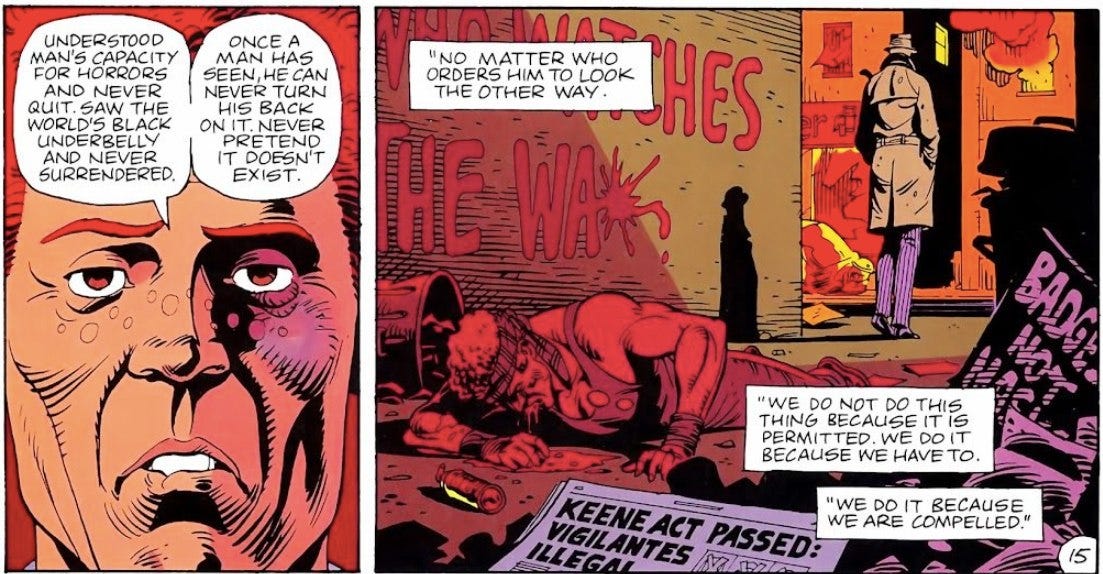
The one kind of posting I cannot resist is something that was my trademark back in my Twitter/Bluesky days—mocking the very act of posting itself. It was in that spirit that I posted on Facebook and Substack Notes (to virtually no acclaim) the above self-aggrandizing quotation by Rorschach from the classic comic Watchmen, with the caption: “Shout out to all the people out there in the trenches, posting day after day.” The addicted poster knows, as Rorschach does, that everything is at stake in their activities. They have seen into the reality of boundless ontological conflict and know their only option is to fight—for themselves but above all for the innocents who will be collateral damage if people are allowed to be Wrong on the Internet. They do not do this thing because it is permitted. They do it because they are compelled.
This post is not a plea to put aside anger in favor of rational discourse, or not only that. I do not believe we can or should put aside anger. When properly attuned, our anger gives us valuable information. We should be angry sometimes, including at specific people. We should not allow others to push us around or insult us or manipulate us, because we all deserve basic respect as human beings. Nor do I want to suggest that anger could or should be excluded from politics—we should be very angry when the people we entrust to oversee our collective affairs break their promises or abuse their provisionally-granted superior status.
The problem, though, is getting one’s anger properly attuned. That is easier than it sounds, especially in a passive-aggressive society that so often scapegoats justified anger as a rationale to continue the very injustice that prompted it. But in the social media amplification field, it is absolutely impossible. No one is strong enough—everyone who participates to any significant extent is sucked in. And the result is that the political potential of our anger is systematically misdirected. This typically happens in ways that are recognizable from meatspace political dynamics. Conservatives tend to misdirect their anger to those of perceived lower status, whose vaulting ambition is disrupting the social order and causing every problem, rather than the powerful business and political leaders who actually are disrupting the social order and causing every problem. Liberals tend to castigate irrational and apathetic individual voters, instead of the losers and empty suits who squander nearly every opportunity to win elections by actually making people’s lives better. And leftists know exactly who’s to blame—their slightly incorrect fellow leftists, whose foolish confusion is the only thing preventing everyone from accepting the Obvious Truth.
In any case, though, the prescription is the same as Rorschach’s: the malefactors must be punished. They must be attacked, insulted—ideally made to show their true colors as a teachable moment for any onlookers, but punished in any case since we already know “all we need to know” from the telltale signs that only we can perceive. Everyone is a self-styled political vigilante, spreading misery in the name of the greater good, viewing people’s disgust at their behavior as the surest sign of their correctness. The worse it gets, the higher the stakes and the greater the disinhibiting effect. The weak (like me, as it turns out!) are weeded out and only those who can handle the constant influx of anger remain, making the environment even more extreme and revolting. They will never stop, never compromise—until every last person who dares to threaten their existence by asking a question is exterminated.
I noticed that same feeling; that I was addicted to the “Someone Is Wrong on the Internet” Syndrome. There’s something about my personality that makes it especially intoxicating. The thing that clicked for me is that I’m a criminal appeals lawyer. It’s literally my job to tell people they’re wrong, at length, and with copious supporting documentation. But very often instead of indulging my SIWOTIism in a healthy way that benefits my clients, society at large, and is very personally remunerative, I was wasting my life arguing about bullshit.
I have read your post the morning after reading this post on the confusing and sad recent history of hating on white male DFW/Bernie fans:
https://open.substack.com/pub/thepointmag/p/from-wallace-bros-to-bernie-bros?r=2lm9cf&utm_medium=ios
A quote from its conclusion:
“It’s easy for me to imagine a millennial man who recommended Infinite Jest to his dates in 2010 very animatedly recommending Bernie’s call for Medicare for All to them in 2015. For some number of years, to point something like this out would be to make a self-evident joke at the expense of such a man. But what exactly was the joke? If you can answer that question, then you would have a key to the entire mood, the whole structure of feeling, of a cultural moment that remains, for better and worse, closer behind us than it sometimes appears.”
Social media seems uniquely capable of generating pointlessly self-destructive leftist/progressive social movements. The addictive quality of the anger you describe in your post seems to have some explanatory power here, explaining why something so self-destructive is also paradoxically self-sustaining.