
Everything in its right place
How to fail to build a new world

This summer I have been reading a lot about art. I am working on two fairly intense projects simultaneously — writing an introductory book on the field of political theology and prepping for a new Shimer history of science class — and it has been a real pleasure to have a mental release that has nothing whatsoever with my immediate teaching or research. And since I have no need to become a proper or credentialed scholar of art history, I have followed my own idiosyncratic taste, sticking with a couple authors I like (Svetlana Alpers and T.J. Clark) and using them as windows into artists that I am less familiar with.
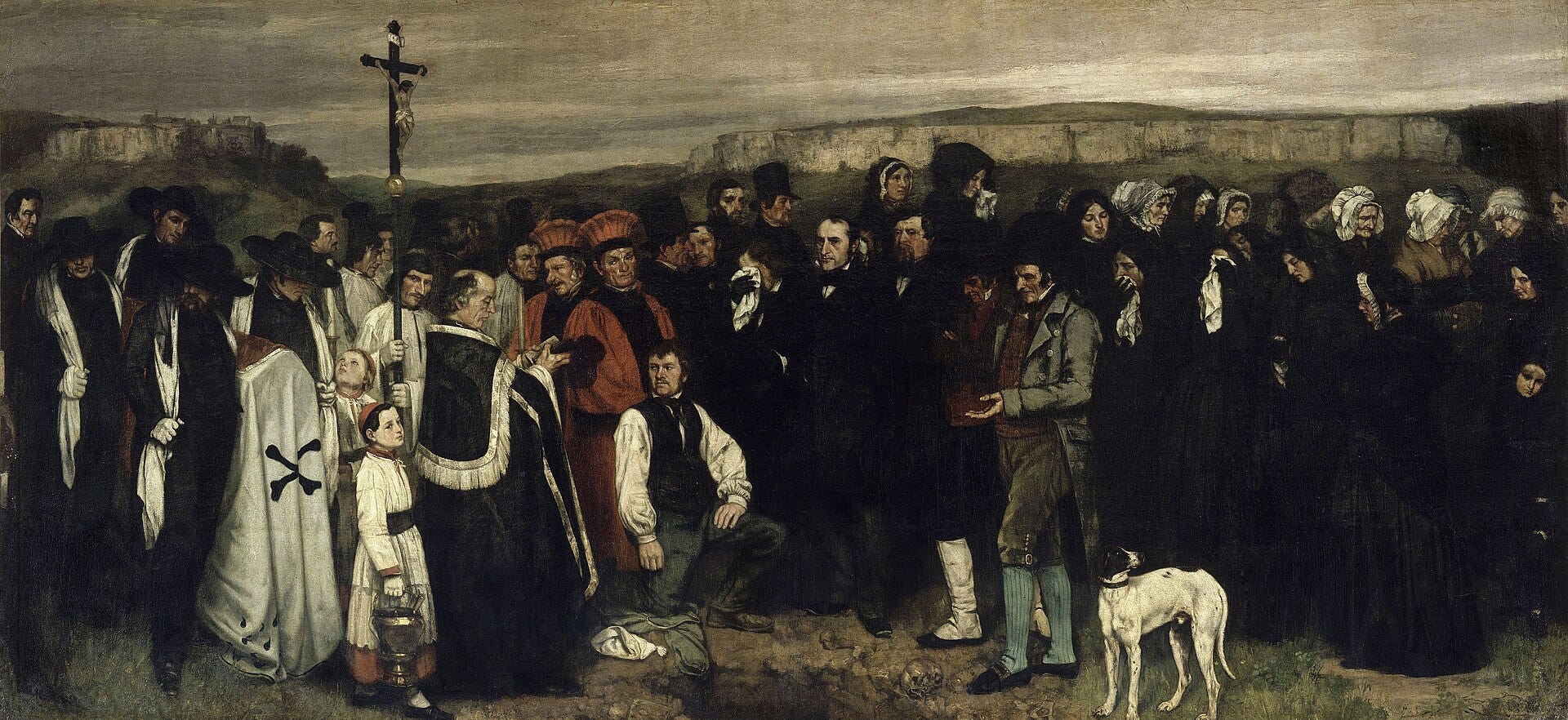
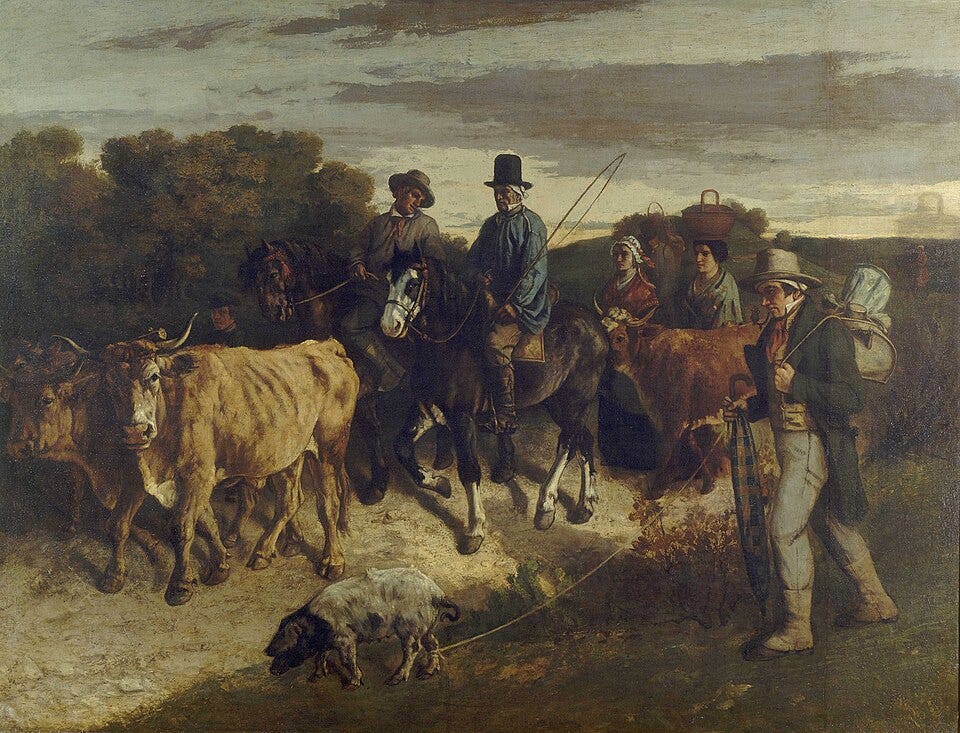
My most recent read in this vein was T.J. Clark’s Image of the People: Gustave Courbet and the 1848 Revolution (1973), which aimed to account for why a trio of paintings that Courbet showed at the 1850 Salon in Paris—namely, A Burial at Ornans, Stone Breakers, and Peasants of Flagey Returning from the Fair—produced such an explosive reaction, outraging the critics at the same time as it gained him instant favor among the people. Thus the book was a double-dip, helping me to become more familiar with an influential artist I know little about and also with a tumultuous era in French history that I always feel vaguely guilty about not having a firmer grasp of. (After all, every leftist should have the history of France from the Revolution to the Paris Commune memorized!)
Clark’s answer to this apparently quite recondite question struck me as very relevant to our own recent history. Basically, Clark contends that Courbet’s paintings destabilized a load-bearing myth in French society at the time—namely, the myth that the class structure was orderly and stable, with everyone in their right place. Peasants were out in the country and quite happy to live their simple yet wholesome life out there, while the bourgeois were in the city and eager to test their merit and mettle there. In his choice of subject matter as well as his means of presentation, Courbet showed this easy sorting out of things to be false. The country was not an idyllic land of happy swains, but a site of conflict just as much as the city.
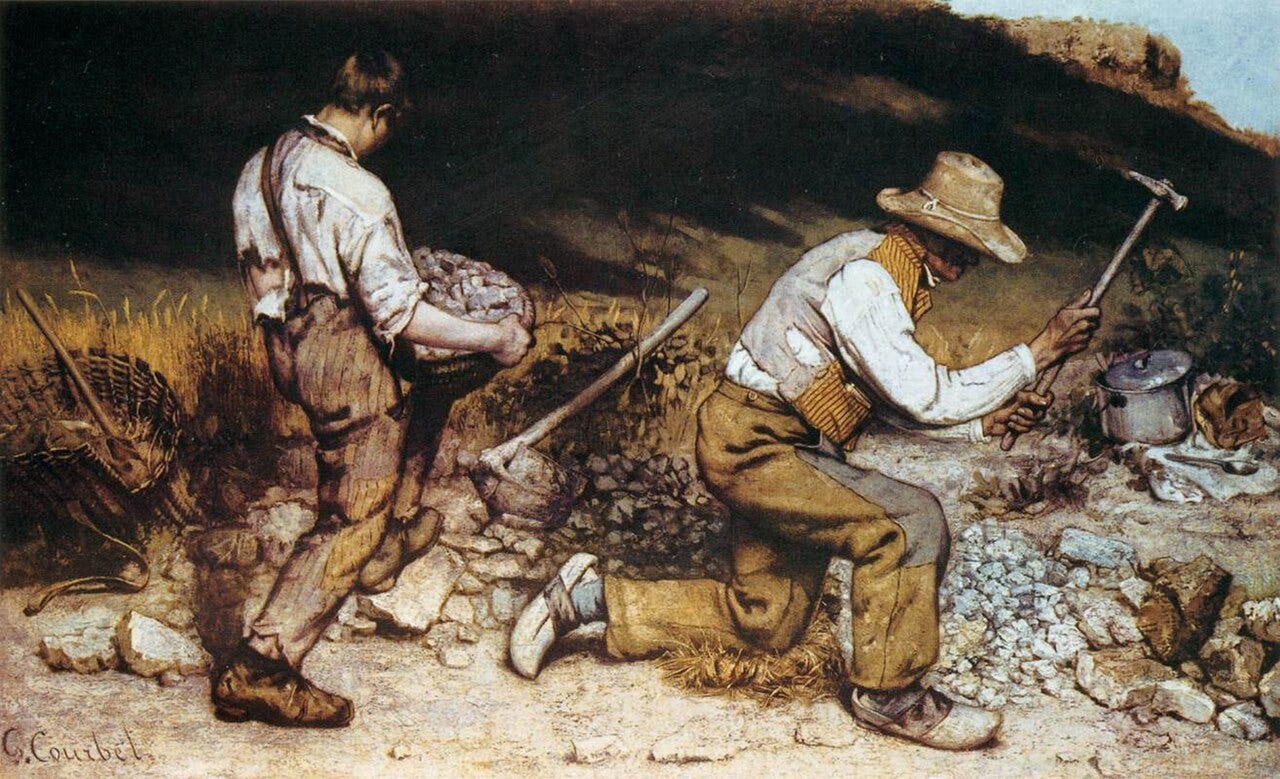
In Stone Breakers, he depicts peasants who have been implicitly kicked off the land and constrained to work at a hard job that dehumanizes them and distorts their bodies. In A Burial at Ornans and The Peasants of Flagey, Courbet shows that all classes are represented in the country, and in his weirdly uniform manner of presentation, which especially in Peasants is fairly jarring and unrealistic despite his reputation as a leading Realist, he at once brings them together into the same scene and yet shows how they cannot be harmonized into a uniform structure. (Clark especially highlights the visual awkwardness of the guy with the pig.) Worst of all, in A Burial, Courbet undercuts the visual distinction between bourgeois and peasant, who wore the black suit and the peasant blouse, respectively. Since peasants might also wear a suit as their “Sunday best,” the viewer can’t tell who is who—and one of the most fascinating revelations of Clark’s research, which typically involves poring over all the journalistic responses to the Salon in a given year, is how the critics all make different assessments of the class status of the mourners, yet are all absolutely certain in their judgments.
The reason that the critics, as representatives of the bourgeois ruling classes, hold so tightly to the myth of the easy, seamless geographical and visual distinction between classes is because it allowed them to deny the reality of profound instability and conflict. Far from being a stable realm of content simple folk and striving meritocrats each occupying their proper place, French society was actually a tinderbox, which would erupt in Louis Napoleon’s 1851 self-coup, made famous by Marx’s Eighteenth Brumaire.
As a citizen of a nation currently ruled by the perpetrator of a failed self-coup, my ears naturally perked up at this point. And then I thought of all the many overly tidy categorizations that dominated the social scene in the years leading up to Trump’s return to office. Like the critics at the Salon, the advocates of those categorization would castigate artworks that violated them in seemingly exaggerated terms, as though fearing that one ill-judged episode of Big Mouth might lead to the end of gay marriage, and like the public who favored Courbet’s work, many everyday people began to find the violation of those categorizations as cathartic.
I emphatically do not want to be heard as saying the “wokeness got us Trump.” I do not think that. In fact, I think that view is stupid. And neither do I think that Clark is saying that the class-based “political correctness” on display in 1850 was to blame for the self-coup. Rather, he seems to me to be saying that the 19th century French P.C. was a symptom of the deeper problems that gave them Louis Napoleon—or better, a failed attempt to master them.
Clark is buried in the details, and as a good leftist (as well as an excellent art historian), he does indeed know the history of the era like the back of his hand. For us lesser mortals, it is perhaps helpful to take a step back and reflect on how new the kind of society the French were building was. They were adopting a new mode of economic production and a new class structure to match, and in the wake of the Revolution, they were doing it without the guardrails of traditional authority (which England, for example, had preserved). The shock of discontinuity must have been profound, and it was renewed every decade or so in a fresh revolution or coup d’état. We are told that capitalism is natural, but it is not. Everyone was making up what a market society should look like as they went along, often with ample servings of arbitrary violence. And in that setting, it is humanly understandable why some people would want to imagine that there was a ready formula that would sort everyone into their right place and thereby resolve the conflict once and for all.
Fast-forwarding to our own time, we as a society are also trying to do any number of radically new things. For instance, we are trying to build a society of equals with a population that has been deeply shaped by the modern concept of race. It is not clear how to do that, because the modern concept of race was invented for the express purpose of declaring different human groups to be permanently and intrinsically unequal. There is an inherent paradox to this effort, because we cannot reverse the historic harms of race without reinforcing the continued existence of race as “a thing.” This is further complicated by the fact that, among subaltern groups, race also has become an important, and positive, identity marker and, among a growing subset of the white population, race has emerged as a toxic identity marker centered on grievance and perceived persecution. Indeed, white people have seized on virtually every tool for achieving racial justice and either abolished it or reappropriated it to reinscribe white privilege.
Relatedly, the U.S. and, in different ways, most of the former imperialist nations have been engaged in an unprecedented project of revising their own historical self-understanding, but in the absence of any significant change in power structures or identities. Without being conquered or undergoing a revolution, they want to create a history with a mournful rather than celebratory tone—to take the perspective of history’s victims while remaining its victors. I believe that the historical narrative generated by this attitude is true, or at least truer than the former “official narratives.” The American Founders were human scum. American history has largely been a nightmare of racism and oppression. Our Constitution was a corrupt compromise to get the slavers on board, and when push came to shove, it didn’t even succeed at that evil goal. People should know and acknowledge those things. But how exactly do you run a nation-state on a narrative like that? What is the purpose, the intended outcome, of that kind of historical self-identification as the villain, if it is not to renounce the power structures and identities that produced the villainy? Is the goal really just to hold the wounds open forever?
On a more positive note, we are also trying to build a society in which all forms of consensual sexual pairings are treated as equally legitimate, with the implication that all forms of gender identity or sexual orientation are to be affirmed. There are precedents for any number of aspects of this project in past societies—the occasional recognition of a third gender, the institution of certain forms of homosociality where sexual contact was tolerated or even encouraged, etc., etc. As an overarching agenda, though, it is radically new. I personally think it’s a great and necessary thing! I support it 100%! But it is simply a fact that no society has proposed to deregulate sexuality and gender identity to such a profound degree before.
Finally, we are presumably trying to build an economically and environmentally sustainable society with a high and improving standard of living. That has never been achieved or even seriously attempted before. Steady state societies have generally been characterized by misery for the vast majority of the population and pockets of comfort and freedom for a small elite. Even they tended to deplete the soil over time, in part due to lack of knowledge of ecological principles but also because large-scale agriculture is, at the end of the day, an extractive process. As for the hunter-gatherer societies that “lived in balance with nature,” their populations were radically smaller than ours and their material and intellectual culture was vastly lower than we would or should tolerate. Despite being abstractly “better,” they were competed out of existence by agricultural societies’ higher birthrates and correspondingly larger footprints. As for an energy “transition,” in the sense of swapping out fossil fuels for renewables, nothing like that has ever happened, ever in human history. Whenever a new source of energy is developed, it is added to the range of options and humans find ways to use up the newly increased total capacity. Other than oddball cases like whale blubber, the old options don’t simply drop out—for example, humans burn more firewood today than ever before. Once again, I fervently believe that this transition has to happen. But I am just observing that it is something new, something we as a human race do not already know how to achieve.
All four of these examples are incredibly urgent and incredibly challenging problems. The first two are about self-consciously reckoning with our historical legacy in a way that humans basically have never done before in the absence of mass violence. The second two are about innovative projects to expand or preserve the range of human possibility, in ways that previous societies and generations did not seriously attempt to do. Confronting any one of them is scary—facing them all at once is frankly terrifying. And among a certain highly visible, highly influential segment of our intellectual and institutional leadership, the response to this difficulty is to pretend that it simply doesn’t exist, that it is not only already known, but obvious what to do.
Or more precisely, it is already known and obvious what one must say about these problems. All of them have become the subject of certain verbal rituals that are treated as absolutely mandatory, even as they are ever shifting. The tendency over time is for the standards to become ever more arbitrary and baroque—for example, to replace the familiar term “Hispanic” with “Latino” (despite the fact that both equally refer to a European heritage) and then try to fix the problem of the inappropriately gendered “Latino” with verbal novelties like “Latinx” or the unpronounceable “Latin@,” or to insist that a core structure of English grammar needs to be revised so that a small subset of trans people can feel more comfortable when people are talking about them in the third person (which, I cannot resist pointing out, most often happens when that person is not actually present). And as the standards become more and more artificial, the reactions to any perceived violation become more and more visceral and extreme.
Again, I do not want to be heard as anti-“woke” here. I embrace and affirm everyone’s sexual identity, and I do my level best to use appropriate pronouns when requested, just as I am happy to refer to any ethnic group using the term they find most respectful. As an ally, though, I do wonder why these are the asks. If the primary goal is to get people to accept that “trans women are women” and “trans men are men,” why this foregrounding of gender indeterminacy, and why in a form that most people are likely to trip up on, repeatedly? Even if the goal is to undermine the gender binary—and I say go for it!—why is this particular linguistic performance the priority? Similarly, I wonder why anyone—anyone—was pondering what to do about that troublesome “o” in “Latino” amid a growing bipartisan consensus in favor of restricting immigration and expelling undocumented immigrants, disputing only the level of violence they feel comfortable using to that end.
I know that liberals are sick of hearing about it, that they’ll say it’s no big deal, or that no one is using that terminology or forcing it on anyone. Fine! But if it’s not a big deal, then it’s not a big deal. That very defensiveness is part of the brittleness I’m talking about. Even in its verbal rejection of the linguistic rituals, it is treating it as the thing—except at this stage, it’s been decided that the problem is not violating standards, but reminding people of their existence.
But it’s not the thing, in any sense. First of all: yes, it is true that Afropessimism did not make anyone racist. Fussiness about pronouns did not make anyone transphobic. Land acknowledgments and plaques clarifying the Founders’ shady past did not turn anyone into a nationalist. And by the same token, the correct verbal performances did not convert anyone to the cause of justice, nor did they materially advance the interests of anyone. It was all simply irrelevant, a kind of O.C.D. performance meant to disavow the actual problems and tensions in society. The climate change case, which may seem to be an outlier in this list, is actually the clearest example, because literally just referring to the “climate transition” is basically all that any politician has concretely done about it in living memory. At least in the case of racial justice or historical reckoning or sexual freedom, there have been material actions taken—the “climate transition” is solely a creature of discourse, a purely virtual, verbal reality that exists only in position papers and expensive conferences funded by fossil fuel-producing countries. (It feels somehow emblematic that the one large-scale exception, Biden’s climate bill, was only passed on the condition that it would not be talked about. The Inflation Reduction Act was truly the climate law that dare not speak its name.)
Yet even the quite reasonable demand to shut up and do something can itself be absorbed into this circuit of verbal ritual, as when a chorus of social media leftists refers vaguely to the need for “organizing” as a kind of rhetorical trump card. On one level, the only harm done by this kind of phrase-mongering is to make us look foolish and ineffectual, but the more insidious danger is that we have let it distract us from the fact that we actually are foolish and ineffectual. It really is the case that we do not know what we’re doing, because the things we want to do are new. So I’m not advocating just getting out of our own heads and into the streets. We need to be in our heads, but in the right way. We need to sit with the reality of our situation. We need to face the terror of the new, and the inevitability of risk and failure. And we might even need to talk to each other—indeed, argue with each other, sometimes fruitlessly! But to do any of that, we need to give up our little comforting ritual phrases and our cathartic denunciations and dogpiles, because they will keep helping us to achieve exactly what they were designed to achieve: nothing.
I don't think you're entirely correct about the lack of any climate transition. In America, perhaps. But electricity generation in several European countries has indeed made great strides away from fossil fuels. 99% of Sweden's electricity comes from renewables or nuclear power. In the UK, the proportion of renewable electricity generation went from less than 10% in 2010 to over 50% in 2024. It's fine to note that more could be done, and that many other parts of the world have made less progress than this. But when you say it's all talk, you make it sound like meaningful changes of any kind are politically impossible everywhere. That's just not true.