
Summertime Blues
On the seasonal suspension of reality

For literally as long as I can remember, my life has followed the rhythms of school. I went from public school to college to grad school to teaching with virtually no interruption. Hence summer vacation has always been a defining feature of my life, a structuring principle of my deep sense of time. For roughly one fourth of the year, life is suspended. Nothing counts, nothing is real. It’s a time of great pleasure, but also a time of great melancholy — a melancholy that hollows out the pleasure in a way that contributes to the sense of unreality.
We all have many childhood memories of summer vacation, that feeling of freedom but also trappedness, the long stretches of boredom, the family vacations that somehow fail to be “for” any member of the family as each quietly endures on behalf of the others’ supposed enjoyment. For me, those family vacations were especially trying, because it was either a family camping trip or, worse, a forced march through a week of “church camp.” To be always dirty, to have no privacy, to have too much structure but at the same time not enough—camping was miserable for me. But it also felt strangely low-stakes, unreal, over before you knew it. The vacation itself would be packed away along with us into the car, leaving nothing behind but one more square of grass for another family to park in for a week or so.
For me, summer was always a time for big projects, a time when the horizon opened out and allowed me to imagine achieving great things. Sometimes those achievements were of limited lasting value, such as reading through an entire series of fantasy novels or really getting to the bottom of Mario 3. Sometimes they were revelatory, as when my piano teacher gave me a long, challenging piece of music to poke at over the summer and was shocked the next fall to discover that I’d mastered it. But whatever the projects were, they always felt somehow unreal, in part because they were private and self-enclosed, but also in part because they would just peter out. The piano achievement is a case in point—even though it created a shift in my subsequent piano lessons, it didn’t lead anywhere during summer vacation itself. I wasn’t inspired to seek out more music on my own. I didn’t show off to my parents or anyone else—actually I kept my practicing to times when they weren’t home so as not to bother them. I didn’t even realize I had done anything impressive until Mrs. Miracle expressed surprise. She gave it to me to keep me busy over the summer, and it did.
As I grew older, I took on more projects that I expected to have some issue in my real life. During grad school, for example, I would typically take on a major foreign language reading project every summer—first French, then German, then Latin and Greek and Italian…. Again, these were very recursive projects. I wasn’t learning to have an actual conversation with anyone, but to gain nuances in original texts that were not available in translation. It was a matter of figuring out the rules to a certain type of puzzle rather than of living dialogue. As a result, I can decipher signs and museum placards and newspapers in basically all of Western Europe, but I can hardly order coffee in the local language. My knowledge of languages, impressive though it may be in some ways, is nevertheless unreal—pleasurable, certainly, but also tinged with the melancholy of isolation.
The real breakthrough was when I realized that summer could be for writing. While I nursed fantasies of writing fiction in high school, I quickly learned that criticism and commentary were more appealing to me—and that was tied fundamentally to school. But when I got the unusual opportunity to write Žižek and Theology as a grad student, I realized that the only way to do so without disrupting my progress toward the PhD was to churn it out over the summer.
Under these emergency conditions, I developed the writing routine that has marked roughly half my summers since that time. I discovered fairly quickly that trying to write all day was a losing proposition. I could sustain it for only a day or two at a time, then would be afflicted with longer periods where I could barely write a word. The answer was, counterintuitively, to restrict my writing time, to give myself only a 2-3 hour window, during which all of the day’s writing must be achieved. That restriction had the salutary side-effect of always leaving me feeling that I had more left to say—giving me the motivation to pick it back up the next day.
This routine determined how I shaped the content of my exposition and argument, too. For my method to work, the ideas had to “flow” naturally, one to the other. If I wasn’t sure where I was heading, I wouldn’t be able to hit the ground running the next day and my entire tightrope walk could come to an end. At the same time, though, if it felt too obvious—if my writing felt rote rather than exploratory—I would also lose motivation. Hence for each chapter, I would think in terms of broad themes that I knew I needed to hit but try to discover the path between them along the way.
At the end of that first Hot Writing Summer, I looked back at my manuscript and could not believe what I had achieved. This piece of writing was orders of magnitude longer than anything I had done before, and it was somehow, unimaginably, all one continuous thing. I had written a book, emphatically, not just a pile of pages but something that felt like a book. Everything in my life changed in that moment, when I realized that was possible. But also in that moment, I was sitting alone in my apartment, and none of my friends were available to hang out that night. I wound up getting dinner by myself at Potbelly’s and feeling like I was going to break down and cry, because the biggest and most important thing I had ever done felt completely unreal.
This summer, as I sit down for yet another Hot Writing Summer, I have a more mature perspective. My expectations for immediate emotional payoff are muted if not entirely absent. In fact, I’ve come to realize that I myself am almost irrelevant to the writing process. My moods, my anxieties, my activities outside the daily writing window—none of that matters. This week was my first intensive writing week of this project. In that short span of time, I have been cheerful, deeply frustrated, even hungover, and… it just didn’t matter. Each morning, I met my wordcount, arguably more easily on the days when my mood was negative or I was feeling run down. The writing is the thing—I just live here.
The need for celebration quickly fell aside. Within a couple years of writing the Žižek book, I was taking on summer writing projects just for something to do. I wrote Awkwardness, one of my greatest hits, basically as a lark to keep me busy for the summer between graduating with my PhD and starting my first job. (Attentive readers will recognize that this means I chose to relax from finishing my dissertation by writing a book.) A particularly revelatory moment came when I was writing Sociopaths a few summers later. On the day when I finished the first draft of my conclusion—a task that I found very challenging and therefore especially satisfying—the fact of completing a full draft of my book wasn’t even the first thing I told My Esteemed Partner about when she got home from work.
My writing routine also has the paradoxical effect of making me feel like I have much more free time during the summer—indeed, an intimidating, almost immeasurable amount of free time. It becomes a challenge to fill those hours between writing sessions. This summer I have several projects lined up, many of them very objectively worthy in themselves. I have to prep the Shimer history of physics class, which will require a good deal of challenging reading. I’d like to get my piano skills back up to snuff so I can work on a new piece for the first time in many years. I’m doing some unstructured research into the Dutch masters, ahead of a future trip to Amsterdam (and its museums!). I’m starting to get a hankering to get back into a Hebrew Bible or Qur’an reading routine. I may even pick up a new video game!
Any of these projects (except maybe the video game) would make for a full and rich summer. Yet none of them is real. They’re just side projects, indulgences, something to keep me occupied. And that makes sense: how could they be real if I’m not real, if I’m just a passenger in the writing process? Strangely, then, by using my summer vacations to do an objectively important and ambitious thing, a thing that definitely “counts” for the broader world, the thing that arguably matters to me more than anything else, I have rendered summer vacation even more intensely summer vacation. I have radicalized the gesture of summer vacation to the point where it has disturbed the structure of my subjectivity.
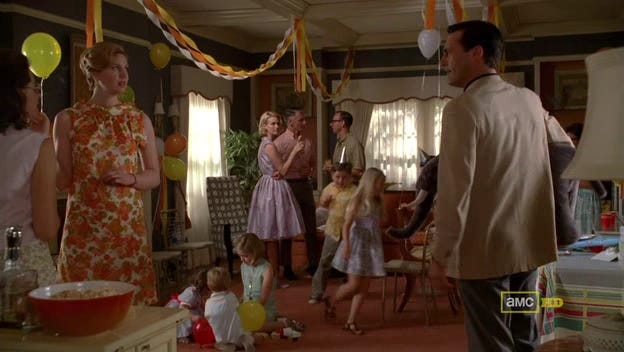
Aside from writing, I also associate summer deeply with Mad Men. It’s not only because for many years it used to run during the summer months. More fundamentally, Mad Men is a summer vacation show in the sense that I describe here. Don Draper is always on summer vacation, and so he is always sad. The scene I chose as the image for this post is, suitably, from the episode “Summer Man”—one where Don undertakes exactly the kind of projects of self-improvement I associate with summer time. He starts journaling, takes up swimming, even tries to regularize relations with his ex-wife and her new husband. It all feels so promising, so overdue, but it is tinged with the melancholy realization that none of it will come to anything. The moment when attends Baby Gene’s birthday party despite being pointedly uninvited by Betty is in some sense a moment of emotional maturity and even something like responsibility—but he is also strangely intruding into his own life, a life from which he has now been excluded.
For me, a scene like that could only happen during winter time. Winter is the season of family obligation, of resentment and passive aggression. Winter is the time when I would be tempted to show up to prove a point. For a long time, I thought that winter was the ultimate truth of my life—the time when the world shows us in no uncertain terms that it does not exist for our convenience, the time of compulsory cheer and faking it till you make it, the time when the childhood vision of an ideal world goes sour. For a long time, everything other than the bitter cold of winter, so cold it could kill you, felt false.
Even if it is true, though, winter no longer feels like my center of gravity, the place where I live. My particular form of arrested development has led me to inhabit summer vacation. I mean this first of all for the literal summer vacation itself. On the one hand, my continued indulgence—I would absolutely never consent to teach a course during the summer, even in the most dire financial straits—has structured my life around the academic calendar. On the other hand, I view summer no longer as “after,” but as “between.” I often spend my spare moments during the spring semester setting myself up for the summer, and then during the fall following up on what I did during those months (responding to peer reviews and copy edits, for instance, or plugging away at a foreign language reading project). I love my teaching, and I’m deeply invested in the institutional service I do, but the real center of my activities is this recurring stretch of wide open space. This space where I experience myself as suspended and irrelevant is somehow simultaneously the place I experience as the real life, the time that really counts, the reality compared to which everything else is a temporary exception.
There is something melancholy about this, perhaps even something false. Perhaps I’m still playing at a game I learned as a child—a game of keeping myself safe from disturbance or criticism. But there is a pleasure in it too, a pleasure in the suspension, a pleasure in the realization that my moods and my stress and my ageing body do not have the final say. As I write this, I wonder what it might be like, for example, to experience my teaching like this, or the vagaries of office politics.
Maybe I’ve discovered something important! In my heart, though, I know that, like all summer projects, this will come to nothing.
I identify with a lot of this, particularly what I’ve come to think of as the mature attitude to writing: the self is indeed a “passenger,” around whom writing happens, like a passenger on an ocean liner around whom crew members swarm, getting somewhere without apparent personal effort. The melancholy you describe is real, and painful, but in my own case I’m starting to recognize that by right-sizing the role writing plays in my own life as ancillary to that life, I’m freeing up space for hanging out with friends, bike rides, and reading with no particular purpose—in other words, pleasure.
My rhythms of life are quite different. But your point about winter resonated. I had a few sad winters a while back. Once you've been sad in winter you can never be properly happy in winter. I solved the problem by moving to Queensland, where we don't have temperate-zone seasons, just the dry season (cooler, but hardly ever cold) and various stages of the wet season (hot and sticky, but not in a way that makes me sad)>