
The Constitution is Killing Us
Or, Why the post-Nixon settlement failed

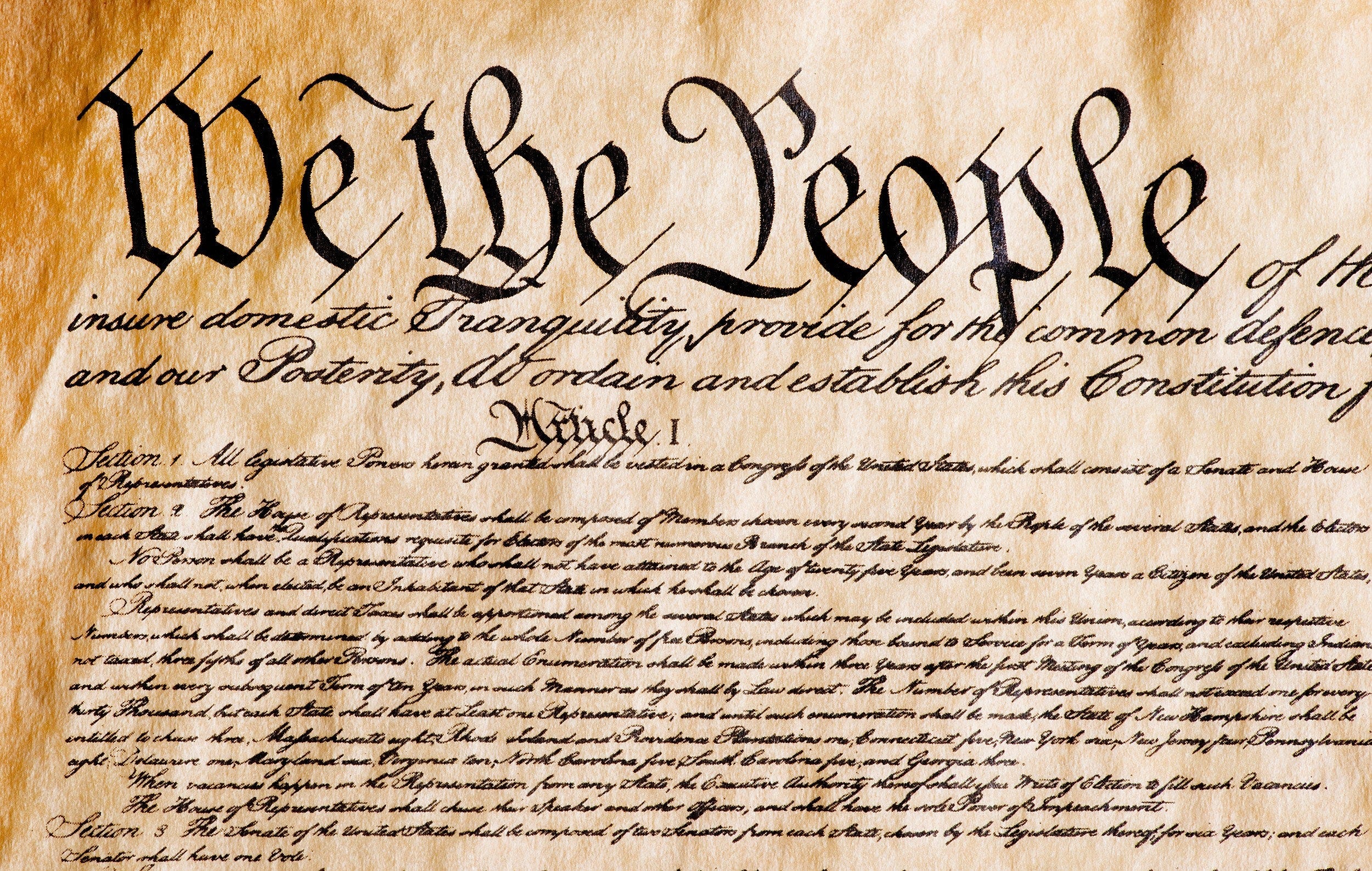
Liberals are addicted to talking about serious political and moral disputes in purely procedural terms. This came out most recently in reporting on the indictment of former FBI chief James Comey, which the original New York Times webpage teaser (since altered) characterized as a break with the post-Nixon norm of an independent judiciary—surely the least of our worries. The emphasis has since shifted to the more substantive concern of Trump’s weaponization of the Justice Department to persecute perceived enemies. One wishes a similar shift had occurred in the Biden Administration’s deliberations about whether to arrest Trump in the aftermath of his coup attempt. In social media debates, I frequently assert that Biden should have ordered Trump’s arrest, and a chorus of liberals always shows up to say that that’s just not how it’s done. The irony that Biden’s studious adherence to the post-Nixon norm—apparently always a gentleman’s agreement rather than a hard legal boundary, given how easily Trump has overcome it—led directly to the return of an even worse Nixon is apparently lost on them.
We can see something similar with the claim that Congress needs to assert its Constitutional prerogatives and start checking and balancing the executive as the Founders intended. This position is advanced most forcefully by Jamelle Bouie, whose work I deeply admire as the most creative and intellectually rigorous attempt to think through how our existing Constitution can become an instrument of genuine democratic self-rule. Yet I cannot help recalling that Congress did assert its prerogatives in the aftermath of Watergate, and the result was to absolutely paralyze the federal government’s ability to do anything at all.
I recognize that this viewpoint is not widespread. I draw it from my reading of Jennifer Pahlka’s Recoding America, which uses her experience in the Obama administration’s 18F initiative as a lens for discussing the gap between policy and implementation at the federal and state levels. I originally purchased the book last fall when I found it was recommended by both Kieran Healy and Dan Davies, whose excellent books I was reading at the time. I only got around to actually reading it late this summer, at which point the United States Digital Service (which housed the 18F project) had been used as a shell to lend some legal plausibility to Musk’s DOGE project. Indeed, I read the bulk of it while literally sitting in an IRS office, waiting for an indeterminate time after making an appointment to discuss why my tax refund had not been issued after seven months. (Nearly two months later, it has still not been issued.)
Hence I read Pahlka’s book—which is full of very sensible suggestions for how to reform government procurement procedures, etc.—as simultaneously a work of utopian fiction and a dystopian “prequel” to the Trump administration. And at the root of all the inefficiencies, whether Pahlka would say it in these terms or not, was obviously the assertion of detailed Congressional control over the executive branch. This led to micromanagement by committee—and worse, by a committee with no direct responsibility for implementing the intricate and often arbitrary rules they crafted. Pushing back or even asking for clarification seemed impossible, as the policy had the force of law and any change was likely to be both endlessly delayed and equally arbitrary. In Pahlka’s own area of concern, the digital capabilities of the federal government, the original sin is a Congressional mandate that government agencies must purchase all software from an outside vendor rather than hiring in-house programmers. But that is only one of many inscrutable mandates handed down by Congress.
This is, to put it simply, no way to run a government. Even aside from the absurdities it generated almost as collateral damage—such as the Carter administration’s decision that the Congressional “power of the purse” mandated the farce of “government shutdowns” in the case of budgetary disputes—it created a general crisis of governability. The ever-increasing morass of Congressional micromanaging made it impossible for the federal government to do its job, and made every interaction with the government increasingly alienating for citizens. The Republicans’ anti-government agenda had no greater ally than this reinvigorated Constitutional order.
I obviously would prefer a return to the old order over Trump’s lawlessness, but that’s simply because I would prefer nearly anything recognizably democratic. But the crisis of governability that the post-Nixon settlement introduced is what gave us Reagan, and it’s what has given us three failed Democratic presidencies, and it’s what gave us Trump. DOGE is not a viable alternative, nor is the increasingly alarming attempt to integrate “AI” into government operations. But the Constitutional division of powers between Congress and the President is not workable for a modern state. We tried it. It failed. The only possible silver lining of Trump’s indiscriminate mayhem would be if he made it effectively impossible to go back, forcing us to undertake a more thoroughgoing reckoning with our constitutional structures. Admittedly, I’m already on record as claiming that nothing can “force” people to do the right thing, but maybe this will be the time events prove me wrong.
I’m not optimistic, though, because the Nixon debacle already should have prompted a fuller Constitutional reckoning—a recognition that the office of the president as specified in the Constitution simply should not exist. It should have spurred an attempt to reform American institutions on the model of nearly every other democratic state. A parliamentary system where the executive is the direct creature of the legislature and can be recalled at any time is obviously preferable, supplemented by a permanent administrative state (perhaps equipped with a pure figurehead to literally “preside” over it—Joe Biden would have been perfect for that role!).
Americans obviously have an allergy to acknowledging that other countries even exist, much less that they’re doing something better. But we also have domestic evidence in favor of an autonomous civil service—namely, the Federal Reserve and the Post Office, both of which enjoy considerable autonomy from partisan pressures and both of which simply work in a way most of the government does not. To the extent that the Post Office does not have the reputation it deserves, it’s because of intentional sabotage by relentless partisan actors, an effort that has now extended to the Federal Reserve itself. So far, however, the Fed has been basically the only center of power to consistently defy Trump by obeying its legal mandate and asserting the legal prerogatives that come along with it. Imagine if agencies like the CDC were granted a similar autonomy within a broad but clear legal mandate!
Obviously this is all a fantasy. The Civil War didn’t convince Americans to abandon the Constitution. Nixon apparently didn’t even prompt serious discussion of the possibility—even after his hand-picked successor pardoned him, an act we are taught to regard as a beautiful moment of “healing” rather than a horrible outrage! We are addicted to the lie that the incoherent compromise struck by a group of slavers and their allies will save us if only we do it right. Well, we did do it right, and it failed. If Trump creates an opening to rethink our social compact and we squander it by trying to make the old Constitution work again, we will fail yet again, setting in train further disasters.
If that isn’t already pessimistic enough for you, here’s another turn of the screw: maybe it’s too late anyway. It’s not as though existing parliamentary systems are proving much more resilient than the US. Neoliberal globalization has rendered essentially every developed country ungovernable, and amid its collapse the only available alternative appears to be a vision of nationalist “sovereignty” that offers only the magical thinking that victimizing racialized others will somehow solve all our problems automatically. In other words, the problem is not ultimately procedural but political and moral—the only ones who want it are the racist populists, and everyone else is stuck in a permanent cringe that they mistake for moral probity. And that brings us full circle back to James Comey! Bookend: achieved. Post: done. Despair: activated.
The poet Dean Young has a lyric in which he reminds us that "the Constitution was written with a feather."
The Supreme Court has “Equal Justice Under Law" carved in stone on its edifice, yet the justices of the court have told the President he's immune from the law. Still think our checks and balances are working? The time for revolution is now, not after it gets worse.