
The Universal Victim
On humanity's obsession with destroying itself

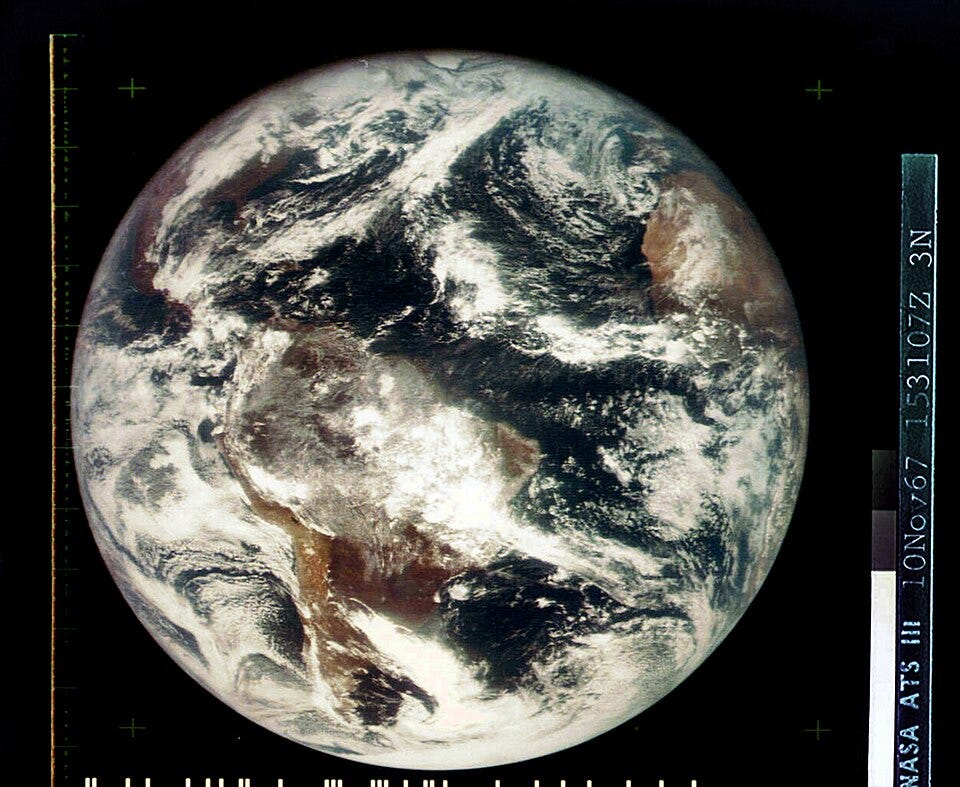
Faisal Devji’s Waning Crescent: The Rise and Fall of Global Islam is a remarkable examination of the political theology of Islam in the modern world. I will be writing more about it in another context, but for now I wanted to highlight a line of argument that is more like an aside. Devji’s main thesis is that the rise of global modernity is when “Islam” as such steps onto the world stage—not quite as a political actor, since it is too big to be represented by any unitary state, and also not quite as a theological actor, since its primary reality is sociological or cultural rather than religious in the narrow sense. (I understand that these are all contestable claims, and if you are inclined to bother me about them in the comments, I encourage you to simply read the book instead.) Part of the interest of Islam as a global reality was that its inclusion of people from all cultures and regions of the world made it a potential avant garde representing humanity as such. This leads Devji to reflect on the paradoxical status of humanity as such:
On the one hand, the species has assumed an empirical reality in our ability to count its numbers, map its extent, and alter its behavior by deliberate policy in practices like mass immunization and population control. But on the other, it has no political reality and cannot represent itself. This is why humanity also tends to assume an increasingly posthumous reality in visions of annihilation by nuclear war, overpopulation, pandemics, or climate change. Essential to humanity’s experience of the globe, after all, is its siultaneously expansive and limited charater. If the human species is too large to represent itself politically, it is nevertheless small enough to be controlled or even exterminated. (pg. 43)
As a subset of humanity, even if an extremely large one, Islam naturally faces the same vulnerability, and much of Devji’s book is focused on the ways that political protest in the name of Islam (exemplarily in riots over images of the Prophet) express that sense of fragility.
I would suggest that the same syndrome of vulnerability afflicts all the major identity categories that claim to represent very large portions of humanity. All of them are in danger, or want to be. When they are not in fact endangered, they create paranoid conspiracy theories to fill the gap. We can see this above all in the category of “whiteness.” Originally created by people who felt themselves destined—even obligated—to rule, it is now a rallying point for those who insist that they are history’s greatest losers. The Great Replacement Theory indeed presumes that the Jews, the true rulers of the world, are engaged in a program to wind down the white race and replace it with more pliant populations. The notorious “fourteen words” of white supremacy are about making the world safe for white children—as it presumably is not already. The very transition from white supremacy to white nationalism, while not actually indicating a change in the content or vileness of the related desires and demands, seems to represent a vibe shift. No longer do they feel inspired to carry the white man’s burden and civilize the world. Instead, they claim, all they want is a safe space to maintain their cultural lifeways (macaroni and cheese, etc.) just like any other ethnic group. Even in the more workaday world of conservative grievance, we continually learn that whites are the victims of “reverse racism” on the part of other racial groups, eager to steal white people’s hard-earned jobs and prestige.
The same logic extends to two signifiers closely allied to whiteness: Christianity and America. Christian nationalists make Christianity into a purely secular sociological identity, much as Devji claims the advent of “Islam” does for the Muslim faith and its cultural trappings, and their constant refrain is that they are under attack. Usually this means that they are being deprived of the recognition or prestige they deserve, above all the recognition that America is and always has been a Christian nation. Their support of Trump stems from their perception that he will finally avenge all the many humiliations Christians have suffered. Meanwhile, Trump justifies his unilateral trade war as an end of the world’s victimization of the United States through a dastardly plot to exchange goods and services for money, and one of the dominant threads of his incoherent and ever-changing justification for the unilateral war against Iran is to paint America as a victim, whether in prospect (a repetition of Bush’s doctrine of preemptive war) or in retrospect (as when Hesgeth claimed that the Iranians started it by taking American hostages in 1979).
I would suggest that this is the natural endpoint of a world where all grand ideological projects have failed. Without ideals, without something to build, politics always falls back into the empty assertion of identity, which (as I suggested in my previous post) is always by definition a zero-sum struggle. The creation of a global free market was the final attempt to escape that zero-sum dynamic through the promise of universal growth, and that project collapsed into illegitimacy as it manifestly failed to create broadly shared prosperity and instead lurched from crisis to crisis. It bequeathed this hateful world to us, in fact, by preserving the old categories of nation, race, and religion in order to set them in competition—only to be finally overthrown by the biggest winners, white Christian Americans, in their petulance at not winning enough.
I don’t know where to go from here. One cannot simply will a collective project into existence. The most obvious available candidate, responding to climate change, itself naturally falls into the logic of reducing harm and has already been eviscerated through the competition among fractious nations (“no fair—why don’t we ‘get’ to destroy the climate as much as the Western countries did!!!”; “no fair—China made cheap and plentiful solar panels, destroying potential American and European manufacturing jobs!”). Nor do I think that vindicating the right identities, the liberatory ones, the ones that were truly victims, would solve anything, even if it could be achieved. If the last few years have taught us anything, it’s that a group that was victimized in the past is fully capable of creating its own fresh victims en masse.
On bad days, I belive, in my gut, that we are truly a stupid and evil species, determined to kill and destroy each other and ourselves over made-up categories that do not matter and even mostly make us miserable—over lines on the ground and idiotic extrapolations from differences in skin tone and authoritative teachings from a radically different world that hasn’t existed in centuries—and that the reason and reflection that have emerged out of the successive layers of evolutionary Rube Goldberg machines that produced us exist only to torment and humiliate us. We have the tools to be so much better, but it is apparently much more appealing to fight over bullshit. Such a pointless waste of the one planet we know to host complex life, and the one means that the universe has developed to reflect upon itself. Even our attempt to reach the stars only lasted as long as the stupid rivalry between the US And Soviet Union—and now, to the extent it’s being contemplated, space travel is being sold not as a brilliant adventure of humanity, but as a way of avoiding extinction on a planet that the same science fiction-obsessed billionaires are in the process of using up. What a stupid waste. What a stupid world.
On the climate change example you mentioned, the shift from broad environmentalism—thinking about how to collectively preserve the quality of air, water, land, and life—to a narrower and much more quantitative focus on “decarbonization” was pivotal. It’s all about competing to (someday maybe) hit our CO2 metrics now, so we always see unrealistic line graphs about “net zero scenarios,” “carbon footprint” discourse that individualizes the issues, and the narratives about how X or Y country is “winning” or “being left behind” in addressing climate change. And even if we did reduce CO2 to like 1980s level or “win” at climate change, then what? It all feels like denial that maybe the big collective project should be doing less extraction, respecting the living world more, and not mediating everything through a computer and a spreadsheet.
The greed and stupidity and evil are definitely built in features. Any ideal that doesn’t recognize that, and dream accordingly, does not have a shelf life. Having said that, it has seemed to me recently that the greed and stupidity and evil have become so overwhelming that a very modest ideal (like a world for the humans, by the humans) seems appealing in ways it wouldn’t have even five or ten years ago.