
Why Christ?
An Easter meditation from a failed Christian

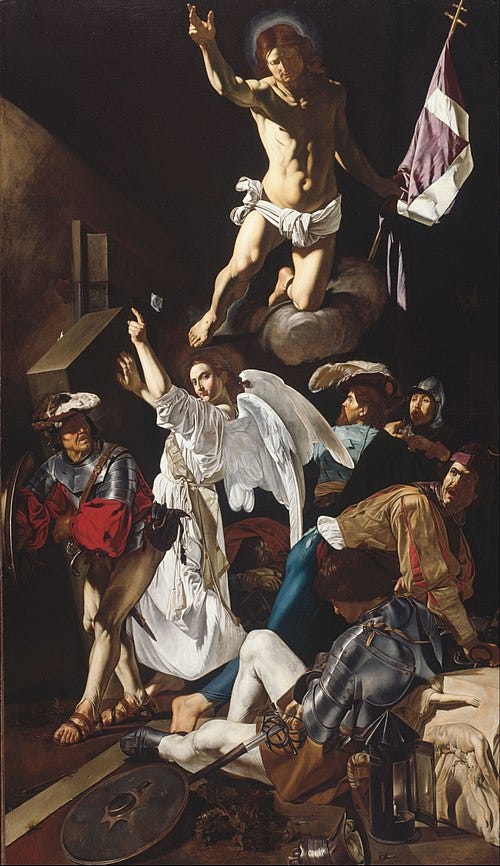
Whenever I see this painting at the Art Institute of Chicago, I always find it mildly blasphemous. Even the New Testament itself refrains from directly portraying the very moment of the Resurrection—all the varied accounts in the Gospels have Jesus’s followers discovering it only after the fact. In Deuteronomy, YHWH declares to the Israelites that they “saw no form when the Lord spoke to you at Horeb out of the fire” (4:15). They saw for themselves that God could not be captured in an image, even when he put in a public appearance, as it were. And as important as that event was for God’s relationship to his creatures, the resurrection is the moment, the decisive moment in the history of creation, the meaning of everything rolled into one impossible event. How dare you attempt to capture it?
I am exaggerating my emotional response, of course. If anything, I was trying to work myself up into something like the response that I might have had at various stages of my life—when I was a teenage evangelical trying to live into the militant opposition to the world that was being demanded of me, when I was a short-lived Catholic convert seeking some kind of clarity and intellectual rigor, when I was a fellow-traveller of a college coterie of radical Christians riding the high of paradox, when I was making one last push in grad school to find the truly liberating and political version of Christianity that I just knew was there.
I have been reliving a lot of those stages over the last year or so, as I work on the research for an introductory book on political theology. I’ve written elsewhere about my own preferred focus within the field, but to do this book responsibly and help the field figure out exactly what unifies all the varied approaches that can be gathered under that umbrella, I’ve cast a much wider net. So alongside the various entries on my personal canon of genealogical-style political theology, I’ve been reading and reviewing the various attempts to formulate a politically-engaged theology, focusing on the modern period and primarily the 20th century. In an exceptionally disciplined year of train reading, I’ve plowed through the theology of the social gospel, Catholic social teaching, Latin American liberation theology, Black liberation theology, feminist theology, queer theology, and much else besides.
Many of these texts were deeply formative for me in my doctoral studies and were foundational for the first couple years of my teaching, so there is an element of nostalgia. But there is also an element of distance, and the question I keep asking is: Why is everyone so determined to make it work? Why does every story have to be routed through this story, every demand legitimated via this authority? The more radically counter-cultural the cause, the more puzzling the insistence on tying it to Christianity becomes. If Christianity was always about the liberation of the poor and the overthrow of the principalities and powers, why did no one get the memo? If a distinctive emphasis of Jesus’ ministry was the equality of women, how did that get so thoroughly buried? If the Gospel and the Church are somehow intrinsically “queer,” why are so many Christians so relentlessly hostile to actual queer people? Again and again, the attempt to ground a political cause in Christianity requires the virtual reinvention of Christianity, the revelation that we have never even known what Christianity was in the first place.
One could of course say the same thing for more conservative appropriations of Christianity. It is far from self-evident that a countercultural preacher that the Romans executed via perhaps the most despicable torture method ever devised would be pleased to become the ideological legitimation for the successors of his murderers. It is surely counterintuitive that a movement aimed at giving non-Jews access to the promises of the Jewish God would again and again become a mortal danger to Jews, or that a theology that proclaimed the end to ethnic division would become the foundation for the cruelty of the modern racial hierarchy, or that the story of an apparently celibate man who hung out with sexual deviants would produce an obsessive focus on enforcing sexual normativity.
The fact that conservative appropriations of the legacy of Jesus have been more frequent and more effective (in their evil way) does not make them any more natural or inevitable. In fact, as the more intellectually honest liberation theologians make clear, everyone, everywhere has always been appropriating the Gospel message in service of their own values and priorities. (I’m thinking here of Ruether in particular, whose opening methodological discussion in Sexism and God-Talk is a truly amazing performance of laying all her cards on the table and yet still winning.)
But that just further raises the question: why involve Jesus at all? Why does anything need to be routed through this odd little story of a guy who wandered around for a couple years saying enigmatically sarcastic things and then got himself killed? When I was going through my radical Christian phase, I remember a listserv thread where people were asserting that the story of Christ is big enough to include every aspect of life, and one very smart, very devout person from outside our circle retorted, quite sensibly: “Come on, no it’s not!” He was obviously right in a sense, but perhaps part of the benefit is precisely that the story is so underdetermined, that there is so little to work with. In fact, the tendency for the development of Christian culture seems to be “the less, the better.” The amount of material on the Virgin Mary in the New Testament is truly miniscule, and only a handful of supplemental narratives were pulled into the dominant tradition from extra-canonical sources. And yet these few stories about the Virgin Mary are foundational for one of the greatest traditions of artistic expression of all time, not to mention the ever-expanding array of sightings, devotional practices, etc.
At the same time, it’s not a pure projection screen. There is a there there, one that perhaps provides some basis for all its many mutually contradictory appropriations. I am speaking of the theme of paradox and reversal, the appeal of the counterintuitive. As Tertullian said, Credo quia absurdum est, “I believe because it is absurd.” He was on solid ground, because Jesus’s teaching relies on the trope of reversing expectations and Paul too proudly declares his message to be foolish and scandalous. For a certain kind of mind—for example, my own—this gesture of you can’t handle the truth holds a deep appeal. There’s a lot you can do with it, from the careful balancing of opposites that is chracteristic of Catholic thought to the obsessive dwelling in contradiction of Hegel or Kierkegaard.
That conceptual form is grounded in the core content of the Jesus narrative, where the brutal torture and execution of an innocent man somehow turns out to be the greatest thing that ever happened. There is room in that story for a lot of things, including solidarity with the poor and suffering and oppressed. But there is a very narrow window of things you can extrapolate from that kind of story that are not completely fucked up. One very natural extrapolation, for instance, is that God simply likes suffering. That simple and straightforward appropriation of the Gospel message led to a thousand-plus years of people intentionally depriving and tormenting themselves, and it has given a ready alibi to oppressors of all kinds of basically as long as Christianity has existed.
Much of the liberation-oriented work in academic theology is an attempt to undo this value of redemptive suffering. The people doing that work are super smart. I value their insights. I share their broad goals. But I don’t think that they can finally succeed in creating a version of Christianity that does not embrace the value of redemptive suffering, any more than you can finally succeed in creating a Christianity that doesn’t view itself as somehow superceding the religious practice of the Jews. There comes a point in “reading against the grain” when you are just producing your own text. And as someone who devoted-slash-wasted over half his life trying to make this particular text work and found that he couldn’t, I wish more people could find it in themselves to just own that they have developed their own values without having to route everything through this one weird guy.
This probably isn’t my best or most rigorous post. I did a better job of this kind of thing with my Easter meditations from a few years ago (Good Friday, Holy Saturday, Easter Sunday). In any case, these are some thoughts I’m having this Easter Sunday.
One thing that’s always struck me about so much of the Christianity that’s not the imperial form (whether it be a fringe form on the right or the left) is the last resort feeling that seems to pervade it. Whether someone has lost their faith in Marxism, or revolution, or environmentalism, nationalism, or capitalism Christianity has always been so ubiquitous, and it shows up in so many different forms, that it always just seems to be there for people when other methods have failed. It’s the existential social safety that changes form, but never seems to disappear. I don’t think it will stop being the existential last resort until something else can provide that net. Even secularism has essentially been dropping people there.
Looking forward to the intro to PT book. Do you devote any space to non-Christian traditions? (I've used your arguments about theodicy and legitimacy quite fruitfully in Jewish PT contexts.)